Online vs In-Person Breathwork Facilitator Training: A UK and Ireland Guide
Looking for a training that works online and in person? Explore the 200-hour Journey The Breath facilitator training →
New to breathwork? Join Pat's free weekly online Community Breathe
Quick answer: The best breathwork facilitator training is not simply online or in person. It is the programme that gives you supervised practice, trauma-informed skills, and enough time to embody the work. Journey The Breath is a 200-hour, six-month online training with live fortnightly masterclasses (Sundays, 10:00am to 12:30pm Irish time, which is the same clock time in the UK) and a three-day in-person graduation intensive in Galway. You can join from Ireland, the UK, or anywhere in the world, with replays available and 1:1 practice sessions scheduled to suit your timezone.
The question most people are really asking
People comparing formats are usually asking something more practical: can I learn to hold space well without putting my life on hold, and will I still get real contact, feedback, and a chance to practise in the room? Those are the right questions. Format matters. Standards matter more. A weekend in a beautiful venue with no supervision afterwards is still a weak training. A well-designed online programme with live teaching, observed practice, case studies, and a proper in-person intensive can be a very strong one.
What in-person training does well
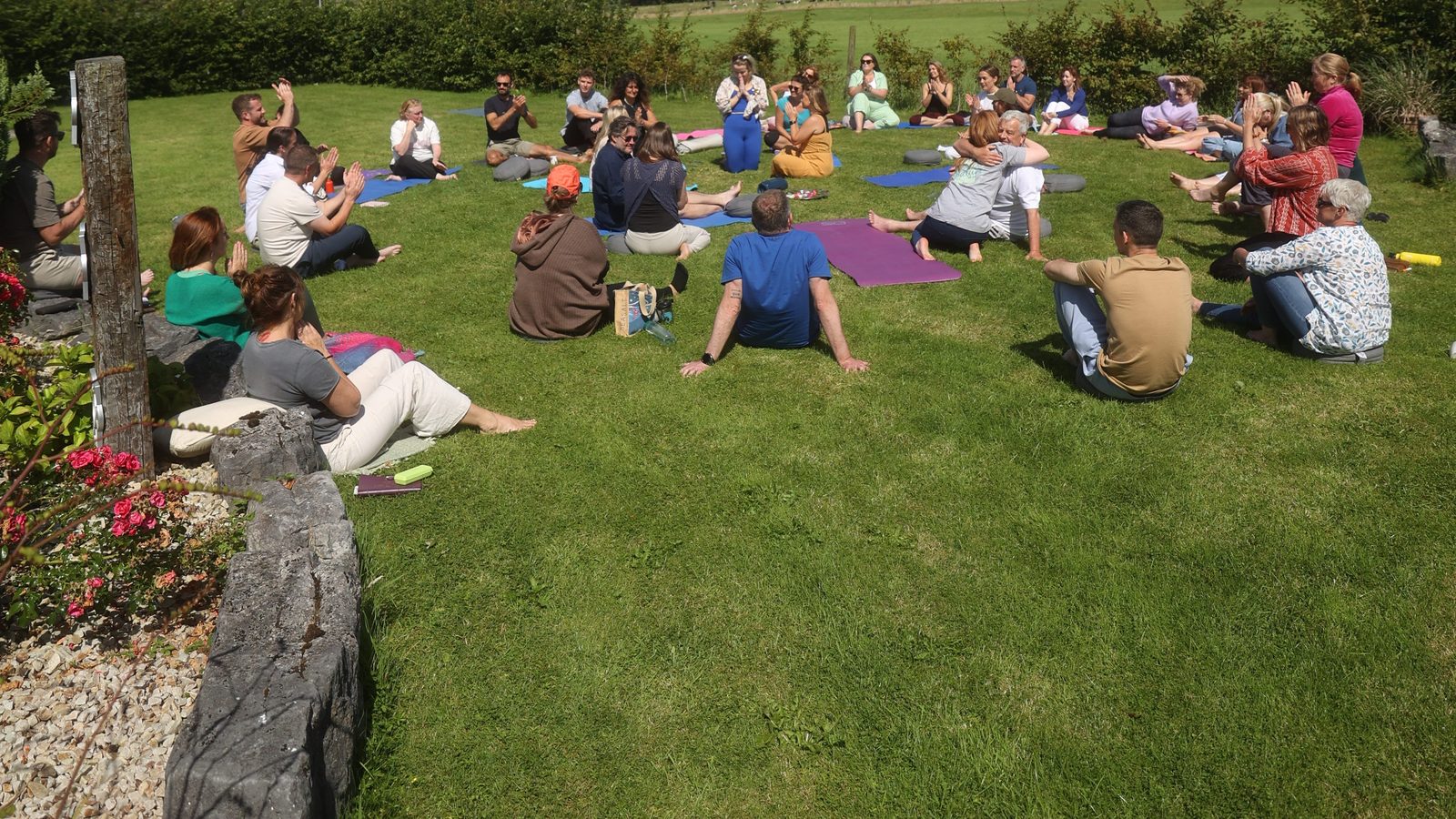
There is no substitute for being in a room with other people. You feel the field of a group, practise proximity, movement, sound, and (where it is appropriate and consented) touch, and see breath patterns in the body, not only on a screen. For many students, an in-person intensive is also where the work finally lands: less theory, more embodiment.
The limits are practical. Fully in-person trainings often ask you to travel, take leave, and pay for flights and accommodation on top of the course fee. If you live far from the venue, or you are building this around work and family, that can rule out otherwise good programmes.
What online training does well
A structured online training lets you stay in your life while you learn. You can practise in your own timezone, return to recordings, and spread the work over months rather than days. That longer arc is useful, because facilitation is less about collecting techniques and more about building a regulated presence you can use under pressure. It also matches how many facilitators now work, including on video.
The risk is quality. Some courses are a folder of videos and a certificate. If there is no live teaching, no observed practice, and no one giving you feedback, you are not really being trained.
A third option: online training with an in-person intensive
For many people in the UK and Ireland, a hybrid path is the most realistic and the most complete: six months online, then a gathering in person to practise in the room, integrate, and graduate. That is how the training is built.
The March 2027 cohort runs online from 21 March to 5 September 2027. Twelve live masterclasses take place fortnightly on Sundays, from 10:00am to 12:30pm Irish time, a workable late-morning slot in London, Manchester, Edinburgh, Dublin, Cork, and Belfast. Live attendance is warmly encouraged, and every session is recorded. On the weeks between masterclasses, 12 pre-recorded somatic skills sessions with support trainer Nicola Herd give you a slower, body-based thread. Your 1:1 practice sessions are scheduled to suit your timezone.
As a reference, the regular Sunday slot is 11:00am in Paris and Berlin, 12:00pm in Athens, 1:00pm in Dubai, 5:00am in New York, 2:00am in Los Angeles, 5:00pm in Bali and Singapore, and 7:00pm in Sydney. Session 1 on 21 March 2027 is before Irish clocks change, so that day it is 6:00am in New York, 3:00am in Los Angeles, 2:00pm in Dubai, 6:00pm in Bali, and 9:00pm in Sydney.
The in-person piece is the Graduation Intensive in Galway, from Friday 17 to Sunday 19 September 2027. Over three days you facilitate in the room, work with integration and embodiment, take part in workshops, and receive your certificate. Lunch is included.
What you actually have to complete
Format only works if the standards behind it are clear. Certification on the training is not issued for watching videos. Over six months you work through all 12 modules and 12 live masterclasses (live or on replay), complete the 12 somatic skills sessions, keep a daily breath practice and log it in a documented practice-hour framework, guide supervised practice sessions (including 16 individual and 4 group sessions) with feedback, write up case studies, and attend the three-day Galway intensive.
After graduation, you also receive six months of group supervision and mentorship, with Saturday calls from October 2027 through March 2028. Dedicated modules cover facilitating online and in person, so you leave able to work in either setting.
How to decide
Choose a mostly in-person training if you need to be in the room every week, can travel consistently, and have found a school whose ethics, supervision, and curriculum genuinely stand up. Choose a carefully designed online or hybrid training if you want vocational depth without relocating your life, and if the programme still includes live teaching, observed practice, and real time in person.
In either case, look past the format and ask: will someone watch me facilitate and tell me the truth? Will I learn consent, scope, and trauma-informed safety? Is the certification recognised by bodies such as IBF and GPBA?
Pat Divilly is an Irish somatic coach and breathwork teacher trainer who has spent 10+ years teaching breathwork and has trained 160+ facilitators across 20+ countries. The training is capped at 40 places per cohort. Enrolment is open for March 2027, and if that date does not work, the next intake begins on 15 August 2027.
Frequently asked questions
Can I complete breathwork facilitator training online and still be taken seriously?
Yes, if the training includes supervised practice, clear certification standards, and recognition by professional bodies. Journey The Breath is a 200-hour online programme with live masterclasses, observed facilitation, case studies, and a three-day in-person intensive in Galway. On completion, graduates are eligible to register with IBF and GPBA.
What time are the live sessions for people in the UK and Ireland?
Live masterclasses run fortnightly on Sundays from 10:00am to 12:30pm Irish time, which is the same clock time in the UK. Live attendance is encouraged, and every session is recorded. 1:1 practice sessions are scheduled to suit your own timezone.
Do I have to travel to Ireland for the graduation intensive?
Yes. The three-day Graduation Intensive in Galway, from 17 to 19 September 2027, is part of certification. You facilitate in the room, work with integration and embodiment, and receive your certificate there.
Is online training less somatic than in-person training?
It can be, if the course is only lectures. This training includes fortnightly somatic skills sessions with Nicola Herd, a daily personal practice, supervised 1:1 and group facilitation, and three full days in person in Galway.
How many hours a week should I set aside?
Plan for around 5 to 6 hours a week over the six months, plus the three-day intensive in September and the post-certification supervision calls that follow.
Thinking about training with us?
If a six-month online container with three days in Galway feels like the right fit, have a look at the Journey The Breath conscious connected breathwork facilitator training. The March 2027 cohort starts on 21 March and is capped at 40 places.
Related guides: Online vs In-Person Breathwork Facilitator Training: What Actually Works · How to Choose a Breathwork Facilitator Training · How to Become a Breathwork Facilitator
