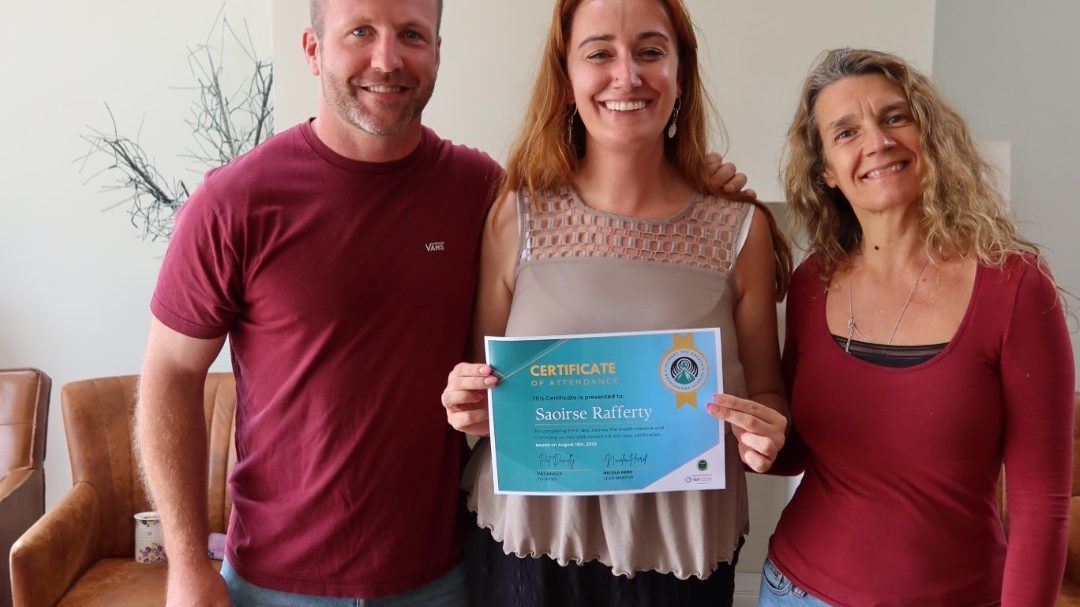
Breathwork Certification: What It Is, Who Sets the Standards and What to Look For
Looking for a certification you can trust? See our 200-hour breathwork facilitator training and certification →
New to breathwork? Join Pat's free weekly online Community Breathe
Quick answer: A breathwork certification is a certificate from a training school confirming you've completed its facilitator programme. Breathwork isn't regulated by law in most countries, so certifications vary widely. Voluntary bodies such as the Global Professional Breathwork Alliance, the International Breathwork Foundation and the UK Breathwork Association publish the standards that help you judge one.
"Is your certification recognised?" It's one of the first questions people ask me on a discovery call, and it's a fair one. The honest answer takes a bit of explaining, because there's no single government-approved breathwork licence. There are schools that issue certificates, and there are professional bodies that set voluntary standards and decide who they'll list.
Once you see how those pieces fit together, it's much easier to look past the marketing and choose a training that's worth your time, money and heart. That's what this guide is for.
What is a breathwork certification?
A breathwork certification is the document a school gives you when you've met its requirements: hours, supervised sessions, case studies, assessments, whatever that school asks for. It says, in effect, "we've trained this person and we're happy for them to practise within the scope of what we taught."
In most places, it isn't a legal licence. Breathwork isn't a regulated profession in most countries, so professional bodies are how the field sets its standards. That's why it matters which body's standards a certification lines up with, and at what level.
Who sets breathwork certification standards?
There are three organisations I'd want any facilitator in Ireland, the UK or Europe to know about. I've linked to their own pages so you can check the current details yourself, because standards change.
Global Professional Breathwork Alliance (GPBA)
The GPBA's professional training standards were ratified in 2003 through the collaboration of some 22 breathwork schools and programmes around the world (GPBA Training Standards). Its 2026 Ethical Standards describe four levels (GPBA Ethical Standards 2026, PDF):
- Ethically Compliant Breathworker: at least 50 hours and 9 months of breathwork training, including 8 hours of ethics.
- Ethically Compliant Breathwork Programme: a programme delivering at least 50 hours over 9 months, including at least 8 hours of ethics.
- Professional Breathwork Practitioner: 400 hours over at least 2 years, including 8 hours of ethics and supervised in-person facilitation, with ongoing personal development and practice.
- Professional Breathwork School: a school delivering at least 400 hours over 2 years, including at least 8 hours of ethics.
The GPBA standards also recommend that a training includes personal development, supervised client work, theory and peer support, with roughly two-thirds to three-quarters of the time spent on experiential work.
International Breathwork Foundation (IBF)
The IBF is an international breathwork network. Its professional membership is self-nominated: members should hold a relevant certificate from a breathwork training programme or school, and the IBF says it doesn't check certificates. It welcomes certified conscious connected breathwork practitioners (around 400 hours over at least 2 years), certified breathwork practitioners whose qualification meets their school's or organisation's requirements, and breathworkers from other disciplines with around 50 hours over 9 months. All professional members agree to the IBF Code of Conduct and Ethical Standards (IBF membership).
UK Breathwork Association (UKBA)
The UKBA is for UK-based breathworkers: resident in the UK or with a significant UK clientele, and with UK-issued liability insurance. Its Professional Conscious Connected Breathwork Practitioner level asks for at least 300 hours of training with no less than 8 months of core training, plus supervised client work after qualifying. It strongly recommends modules on respiratory science and the nervous system, safeguarding (consent, trauma, first aid, contraindications and touch), ethics, client practice and professional administration (UKBA eligibility).
Is a breathwork certification "accredited"?
Be careful with that word. In breathwork marketing it can mean:
- the school is listed by a professional body (and at which level)
- graduates are eligible to apply for membership of a body
- the course carries CPD credits for another profession
- or nothing more than the school's own say-so
None of these are bad, but they're not the same. Ask: accredited by whom, at what level, and can I see the listing? A good school will answer straight away and point you to the body's own website.
Where does Journey The Breath fit?
Here's our position in plain terms, so you can compare it fairly.
Journey The Breath is a 200-hour conscious connected breathwork facilitator training. You're held for 12 months: six months online, three days in person in Galway, then six months of further support through monthly group supervision. The GPBA lists Journey The Breath in its directory as an "Ethically Compliant Program", and that listing says graduates can apply for IBF professional membership and pursue GPBA ethically compliant breathworker status (GPBA listing).
That's different from the GPBA's 400-hour, two-year Professional Breathwork Practitioner tier, and our 200 hours alone don't meet the UKBA's 300-hour figure. I'd rather you know that up front. If a longer, multi-year pathway is what your work or country needs, choose accordingly, or treat a training like ours as a strong foundation and keep building hours.
Journey The Breath includes at least 8 hours of ethics training, in line with the GPBA's requirement for ethically compliant status.
What does a JTB certificate actually mean?
For me, a certificate should mean you can do the work, not that you sat through the content. Our graduates can offer one-to-one and group conscious connected breathwork sessions, online and in person, plus 12 shorter practices to give clients as grounding, daily tools. They've learned how to hold a session, how to programme different techniques around what a client needs, communication principles and how to hold space. You earn it through supervised practice: 16 individual and 4 group facilitation sessions with feedback, case studies and the in-person intensive.
What should you look for in a breathwork certification?
How many hours, and over how long?
A weekend can introduce you to breathwork. It can't make you a facilitator. Compare hours against the body you'd like to join, and look at the time span too. How we study dictates how we show up for clients, and skills need time to settle in the body.
How much supervised practice is there?
Ask how many sessions you'll facilitate on real people, who'll review them and what feedback you'll get. This is the biggest difference between trainings.
Is it genuinely trauma-informed?
Ask what's actually taught. Titration, pendulation, resourcing, the window of tolerance, consent, scope and referral should all be in there, taught by people trained in them.
Does it cover safety, screening and contraindications?
You should leave with a screening process, a clear list of contraindications and a plan if something goes wrong. See Is Conscious Connected Breathwork Safe? and Breathwork Contraindications.
Is there an in-person component?
Online training can be brilliant. I've been teaching online for around 12 years and I'm still amazed at what's possible. But holding a room is its own skill, and in-person time lets everything land.
What happens after you graduate?
Your first real clients raise new questions. Ongoing supervision and community make a big difference.
Will your insurer accept it?
Before you pay, check with an insurer in your country that the certification will be accepted for professional liability cover.
For a fuller framework, read How to Choose a Breathwork Facilitator Training.
Frequently asked questions
Is breathwork certification legally required?
In most countries, no. Breathwork isn't a regulated profession in most places, so there's usually no legal licence. That's why voluntary standards from the GPBA, IBF and UKBA, plus professional insurance, matter. Check the rules where you live, especially if you also hold a regulated clinical role.
What is the best breathwork certification?
There isn't one best for everyone. Look at hours, supervised practice on real people, trauma-informed and safety content, in-person training, support after graduation and which professional body's standard it meets. Then ask to speak to graduates who are now facilitating.
How many hours is a breathwork certification?
It ranges from short online courses to multi-year programmes. The GPBA's tiers are 50 hours over nine months (Ethically Compliant) and 400 hours over two years (Professional Practitioner). The UKBA asks for 300 hours for professional conscious connected breathwork practitioners.
Does the IBF accredit breathwork schools?
The IBF offers organisational membership for schools and self-nominated professional membership for individuals, and says it doesn't check certificates. It will display GPBA status on a member profile after checking it. For formal school standards, look to the GPBA or your national association.
Is Journey The Breath certification recognised?
The GPBA lists Journey The Breath as an Ethically Compliant Program. Graduates receive a 200-hour Journey The Breath Facilitator Certification and, per that listing, can apply for IBF professional membership and pursue GPBA ethically compliant breathworker status.
Can I get certified in breathwork online?
Yes, many certifications are fully online. I'd still look for live, supervised practice on real people and some in-person time. Our training is online for six months, then three days together in Galway, then six months of further support.
Want to see how our certification works?
Everything that goes into a Journey The Breath certification, from the 12 modules and supervised facilitation to the Galway intensive and the six months of support afterwards, is on the Journey The Breath facilitator training page. The next cohort starts on 21 March 2027. If you have questions about how it fits your country or profession, book a discovery call and ask.
Related guides: How to Become a Breathwork Facilitator · What Is Conscious Connected Breathwork?
Sources
- Global Professional Breathwork Alliance, Training Standards, 2026 Ethical Standards (PDF), Membership requirements and Journey The Breath listing.
- International Breathwork Foundation, Membership types.
- UK Breathwork Association, Eligibility for Professional Registration.
Related reading: breathwork facilitator training cost and accreditation and how to become a certified breathwork facilitator in 2027.
