What Is Conscious Connected Breathwork? A Plain Guide From a Facilitator Trainer
Feel called to share this work? Explore our 200-hour conscious connected breathwork facilitator training →
New to breathwork? Join Pat's free weekly online Community Breathe
Quick answer: Conscious connected breathwork is a breathing practice where you join the inhale and the exhale into one continuous circle, with no pause at the top or bottom of the breath. Done lying down for 45 minutes to an hour with a trained facilitator, it shifts your body chemistry and often brings up sensation, emotion and a quieter, clearer mind.
About ten years ago I was at a wellness festival in Costa Rica when someone announced a breathwork session. I didn't really know what breathwork was. I'd tried meditation for years and, honestly, it had never worked for me. My mind just kept going.
So I lay down, followed the instructions and breathed. And somewhere in that session, for the first time in my adult life, my mind went quiet. My body relaxed in a way I hadn't felt before. I didn't have any context for what had just happened, but I knew there was something in it.
That one session started a ten-year path for me. This guide is the explanation I wish someone had given me on the mat that day: what conscious connected breathwork is, where it comes from, what a session actually looks like, what's happening in your body, what the research says, and how it compares to other styles.
What is conscious connected breathwork?
The International Breathwork Foundation (IBF) describes conscious connected breathing as a technique "in which the breather intentionally connects the inhale with the exhale without any pauses" (IBF). People also call it circular or connected breathing.
The way I explain the name to people is simple.
Conscious means bringing awareness to your breath. You take your first breath when you're born and your last when you die, and you take a huge number in between, but we rarely stop to notice how we're breathing. Is it fast or slow? Short, shallow, deep? The breath is a reflection of what's happening in your nervous system, so noticing it is the first step.
Connected means we join the inhale to the exhale, and in doing that we welcome aliveness. When life gets stressful, scary or traumatic, most of us tense and brace our bodies. We hold our breath. We cut off at the throat. It's a clever way of managing emotion. In a session we do the opposite. Instead of managing what we feel, we connect the breath and let energy flow more freely through the body.
The IBF's Science & Research Group lists four components most schools share: connected breathing with no pause, diaphragmatic breathing into the belly, a relaxed exhale that you let go of rather than push out, and breathing in and out through the same channel.
Where did conscious connected breathwork come from?
According to the IBF, many of today's techniques evolved from Rebirthing, a conscious connected breathing practice described by Leonard Orr in the 1970s. Other schools grew from that root, including Holotropic Breathwork, Integrative Breathwork, Shamanic Breathwork, Transformational Breath and Clarity Breathwork. The basic breath is shared. What differs is the pace, the music, the use of touch and the framework around it.
My own path went through a lot of these doors. A couple of months after Costa Rica I found Wim Hof and went to Poland to train with him. It was a great short practice, but I was curious what happens for the rest of the day, which led me to study functional breathing with Patrick McKeown of Oxygen Advantage. Then rebirthing breathwork. Then pranayama, yoga, bodywork and TRE. I studied with Gabor Maté for a year, and I'm now in the third year of a Core Energetics training in body-based psychotherapy. Every one of those deepened my wish to understand the body and the breath.
What happens in a conscious connected breathwork session?
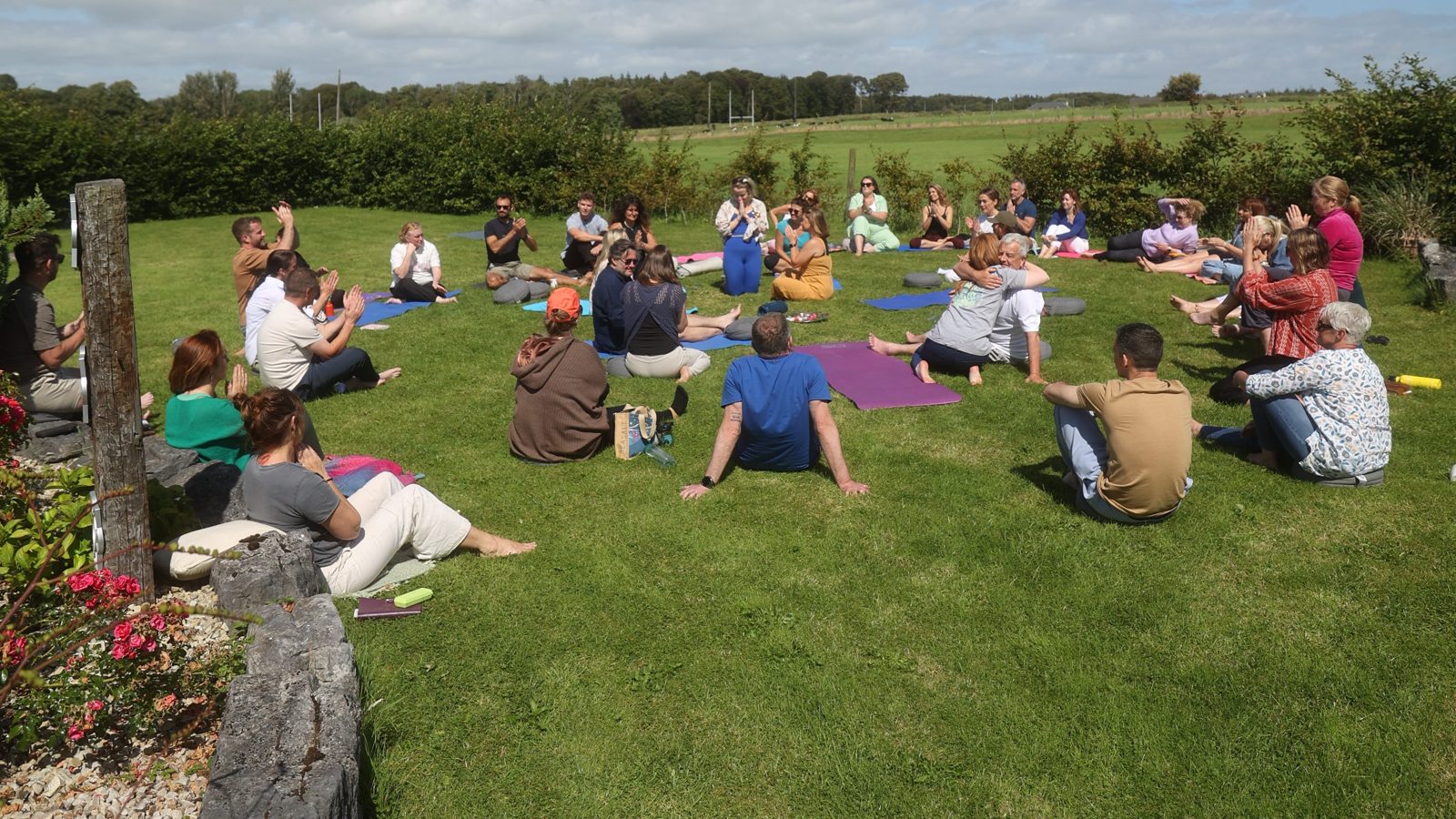
The sessions I teach run for 45 minutes to an hour and have four phases.
1. Opening
We settle in, connect to the breath and ground. Early on we usually meet the busy mind: the ego, the monkey mind, the commentary. "Am I doing this right?" is completely normal at this stage.
2. The build
We connect the breath: a nice full inhale and a relaxed exhale, keeping the connection and using the breath as an anchor. We build a steady rhythm and build energy in the body. Stories will come up. The invitation is to breathe through them. Gradually you feel more sensation, more of your body.
3. Peak
The last couple of minutes of active breathing. Depending on the day, and on the person, we might push a little harder, stay as we are, or ease off gently. This is where the defences of the mind can drop a little and we tune into the unconscious mind, which is the body. You might feel emotions you haven't let yourself feel. Memories often arise. You might meet new parts of yourself. The invitation throughout is to welcome all of it and stay open, with the breath and with the heart.
4. Rest and receive
Usually after around 30 to 35 minutes of connected breath we come into integration. You rest completely and let the insights land. This part is deeply restful and can be very insightful. In a lot of ways it's where the session does its work.
What's happening in your body?
Here's the short version. I go deeper in What Happens in Your Body During a Breathwork Journey.
Normal breathing has a little pause at the top and bottom of each breath, where carbon dioxide (CO₂) builds back up. Connected breathing removes that pause, so it's easy to breathe off more CO₂ than your body is making. Your blood becomes slightly more alkaline, which doctors call respiratory alkalosis (StatPearls). That one shift explains most of what people feel:
- Tingling in the hands, feet and face. In alkaline blood, more calcium binds to proteins, so less free calcium is available to steady the nerves, and they fire more easily (StatPearls: Physiology, Calcium).
- Tight or cramping hands and mouth, often called tetany, when that effect builds further (Merck Manual).
- Light-headedness or a floaty feeling. Low CO₂ narrows blood vessels, including in the brain (Havenith et al., 2025).
A 2025 study that measured CO₂ during Holotropic and conscious connected breathwork sessions found the drop in CO₂ was linked to the onset of altered states of consciousness, and the depth of those states predicted later improvements in wellbeing in that group (Havenith et al., 2025). It's one exploratory study, so I hold it lightly, but it fits what we see in the room.
The thing I most want first-timers to know: these sensations are normal, temporary and expected. If they get too much, you slow the breath down and they ease.
What does the research say?
The honest answer is that it's promising, early and mixed. A 2023 meta-analysis in Scientific Reports found breathwork in general was associated with lower self-reported stress, anxiety and depressive symptoms than control conditions, but most of the studies had a moderate risk of bias, and the authors warned against "a miscalibration between hype and evidence" (Fincham et al., 2023). A 2024 trial found three weeks of brief, remote fast breathing was no better than a well-designed placebo breathing practice in healthy young adults (Fincham et al., 2024).
My own view is this. Breathwork isn't the only way. It's a tool in the toolbox. What it does well is let us come into contact with ourselves, including the difficult parts, in a more gentle way. And difficult doesn't only mean anger, fear or frustration. It also means what's sometimes called the golden shadow: the ways we learned to stay small. Breathwork can open us to more joy, passion, pleasure and aliveness too. The purpose of the journey is to show you patterns you can have more awareness around, so you can make changes in your life with more choice. For me, it's all about choice.
How is it different from other breathwork?
Conscious connected breathwork vs Wim Hof breathing
The Wim Hof Method uses rounds of deep breathing followed by breath holds, often with cold exposure. I loved training with Wim, and it's a great short practice. Conscious connected breathwork is usually a longer, facilitated journey without deliberate breath holds, focused on what you feel in your body and emotions.
Conscious connected breathwork vs functional breathing
Functional breathing is how you breathe day to day: through the nose, slow and low. It's brilliant for calm. But on its own it can stop us meeting our edges, which is an important part of the journey. I think we need both: a regulated nervous system, and the ability to tip into the edges of what's difficult, safely.
Conscious connected breathwork vs Holotropic Breathwork
The IBF counts Holotropic Breathwork, developed by Stanislav and Christina Grof, as one school within conscious connected breathwork. It typically runs longer, with evocative music, usually in groups.
Is conscious connected breathwork safe?
For most healthy adults, guided well, it's generally well tolerated, but it isn't for everyone. People who are pregnant, or who have heart problems, epilepsy, certain mental health conditions and some other medical issues, should avoid it or speak to their doctor first. Never practise in water or while driving. Read Is Conscious Connected Breathwork Safe? and Breathwork Contraindications before your first session.
Can you learn to facilitate it?
Yes. A couple of years after my own trainings I started a free weekly online community breath. People began asking whether I offered a training. It wasn't part of my plan, but eventually I said yes, and it's been the most fulfilling thing I've ever done. If you're curious, start with How to Become a Breathwork Facilitator.
Frequently asked questions
What is conscious connected breathwork in simple terms?
It's breathing in a continuous circle, joining the inhale and the exhale with no pause, usually lying down with a facilitator. "Conscious" means bringing awareness to your breath; "connected" means joining the breaths so energy can move instead of being held. Sessions often bring sensation, emotion and deep rest.
Is conscious connected breathwork the same as Rebirthing?
Not exactly. The International Breathwork Foundation describes Rebirthing, set out by Leonard Orr in the 1970s, as the practice many modern conscious connected techniques grew from. Rebirthing is one school of conscious connected breathwork; Holotropic, Integrative and Transformational Breath are others.
How long is a conscious connected breathwork session?
The sessions I teach run 45 minutes to an hour in four phases: opening, the build, the peak, and rest and receive. Usually there are around 30 to 35 minutes of connected breathing before you rest completely and let things land.
Why do my hands tingle or cramp during breathwork?
Connected breathing lowers the CO₂ in your blood, making it slightly more alkaline. That reduces the free calcium that steadies your nerves, so they fire more easily, causing tingling and sometimes cramped hands, called tetany. It's normal and temporary, and eases when you slow the breath.
What if meditation has never worked for me?
That was me. I tried meditation for years and my mind wouldn't settle. In my first conscious connected breathwork session my mind went quiet for the first time in my adult life. Because the breath works through the body, it can be a way in for busy minds.
Does conscious connected breathwork have scientific evidence?
There's early but growing evidence. A 2023 meta-analysis linked breathwork in general to lower stress, anxiety and depressive symptoms, though most studies had moderate risk of bias. A 2025 study linked the CO₂ drop during conscious connected breathwork to altered states and later improvements in wellbeing.
Can I do conscious connected breathwork on my own?
For your first sessions I'd recommend a trained facilitator. Always breathe sitting or lying down, never in water, the bath or shower, or while driving. If you have a health condition, are pregnant or take medication, speak to your doctor first.
Ready to go deeper?
Journey The Breath, our conscious connected breathwork facilitator training, is everything I wished I'd had when I started. It runs for six months online, ends with three days together in Galway, and then gives you six months of further support. We've trained 160+ facilitators in more than 20 countries, and the next cohort starts on 21 March 2027. Have a read of the Journey The Breath facilitator training page, and if it speaks to you, book a discovery call.
Related guides: How to Choose a Breathwork Facilitator Training · Breathwork Certification
Sources
- International Breathwork Foundation, What Is Conscious Connected Breathwork?
- Brinkman JE, Sharma S. Respiratory Alkalosis. StatPearls, NCBI Bookshelf.
- Sahota RJ, Leslie SW, Sharma S. Physiology, Calcium. StatPearls, NCBI Bookshelf.
- Merck Manual Professional Edition, Hyperventilation Syndrome.
- Havenith MN et al. (2025). Decreased CO₂ saturation during circular breathwork supports emergence of altered states of consciousness. Communications Psychology.
- Fincham GW et al. (2023). Effect of breathwork on stress and mental health: a meta-analysis of randomised-controlled trials. Scientific Reports 13:432.
- Fincham GW et al. (2024). Effects of brief remote high ventilation breathwork with retention on mental health and wellbeing. Scientific Reports.
Related reading: breathwork facilitator training Ireland and how to become a certified breathwork facilitator in 2027.
