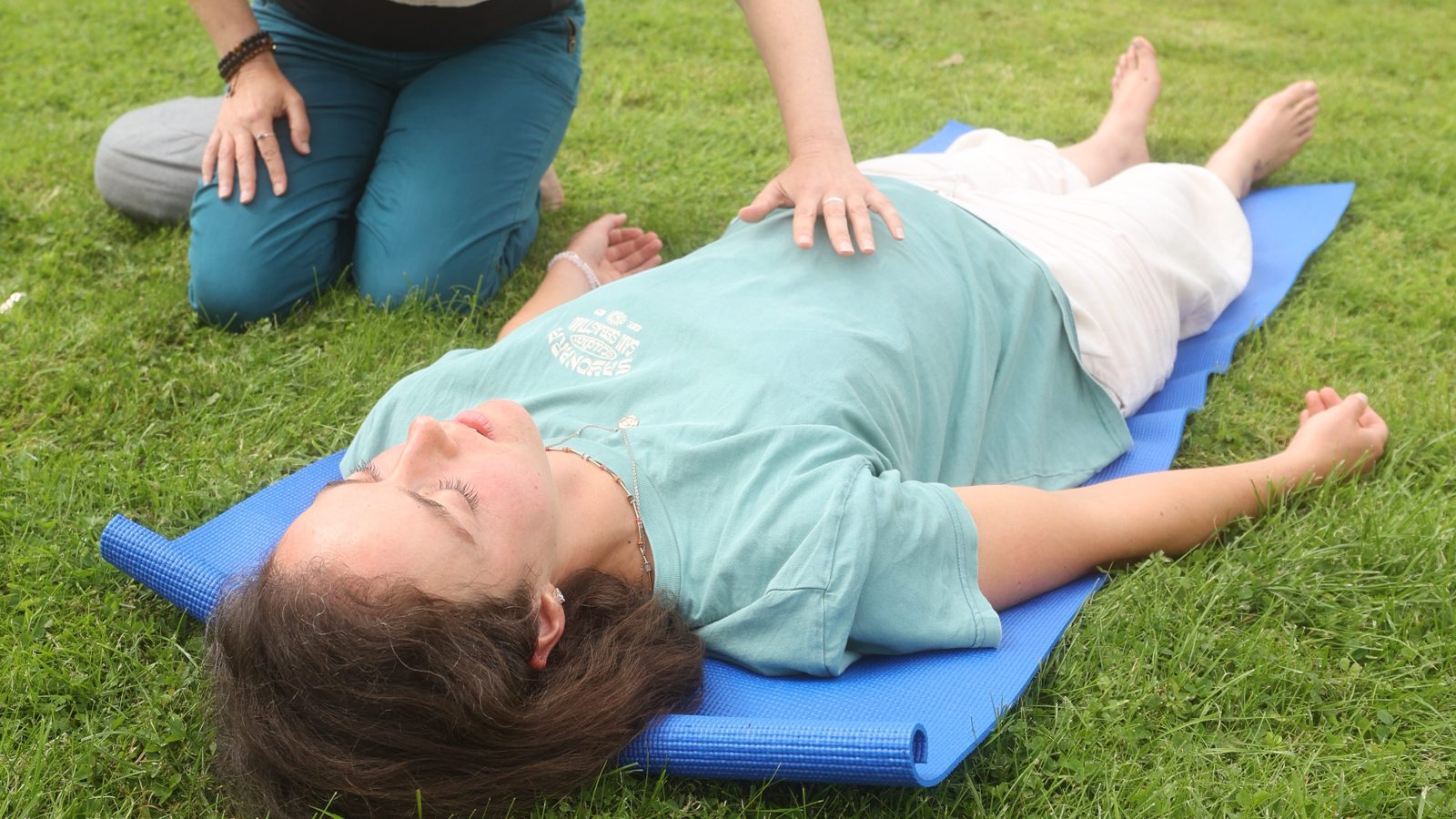
What Happens in Your Body During a Breathwork Journey? The Science, Explained Simply
Want to understand and hold this work for others? Explore the 200-hour Journey The Breath breathwork facilitator training →
New to breathwork? Join Pat's free weekly online Community Breathe
Quick answer: During conscious connected breathwork you breathe off carbon dioxide faster than your body makes it. Your blood becomes slightly alkaline, free calcium drops and blood vessels in the brain narrow. That causes tingling, cramping hands, light-headedness and a quieter mind. Emotion and memory often surface as the body's held tension softens.
Years ago, her keys came back through my letterbox with a note: "I hope you find your happiness." I ripped it up, threw it to one side and went out and got drunk. Then I got busy, for months.
Years later, lying on a mat in a breathwork session, I saw that letter as clearly as the day it arrived, and the grief came with it. My mind had moved on. My body had kept the whole thing.
That's the heart of what I want to explain here: what's actually going on in your body and brain during a breathwork journey, why you feel what you feel, and why things can come up that you thought were long gone. I teach this in three layers, and I'll be honest about which is which:
- Well established: textbook physiology. Carbon dioxide, pH, calcium, haemoglobin.
- Good support: solid research, though often not studied inside breathwork itself.
- Working model: a framework that makes sense of what we see in sessions, not yet proven.
Hold the model lightly and the physiology firmly.
Why is breathwork about carbon dioxide, not oxygen?
Most people assume breathwork floods you with oxygen. It doesn't really. At rest, your blood leaves the lungs already close to fully loaded with oxygen, so breathing harder can't top up a tank that's already full.
What connected breathing changes is the other gas: carbon dioxide (CO₂). Normal breathing has a little pause at the top and bottom of every breath, where CO₂ builds back up. Connected breathing removes that pause. That makes it easy to breathe off more CO₂ than your body is making, especially lying still. The rate and depth of your breath decide how far it drops, which is why the same technique can be gentle or intense.
Here's the comparison I give people. On a run, your muscles make lots of CO₂, so you breathe harder and the level stays balanced. On the mat, you're breathing like you're running but lying still, so CO₂ falls.
What happens when CO₂ drops?
Your blood becomes slightly alkaline
Less CO₂ means your blood becomes more alkaline. Doctors call this respiratory alkalosis (StatPearls: Respiratory Alkalosis). Almost everything you feel physically follows from that one shift.
Oxygen is released less easily (the Bohr effect)
CO₂ is the signal that tells haemoglobin, the oxygen carrier in your blood, to let go of oxygen where it's needed. When CO₂ is low, haemoglobin holds on tighter, so tissues get a little less oxygen even though your blood is full of it (MedLink Neurology).
The analogy I use: the lungs are a depot and haemoglobin is a fleet of delivery vans, leaving almost completely full. CO₂ is each house ringing the doorbell saying "deliver here". Over-breathing turns the doorbells down, so vans drive past still full.
Blood vessels in the brain narrow
Low CO₂ also narrows blood vessels, particularly in the brain (Havenith et al., 2025). Fewer vans get there at all. That's the light-headed, floaty feeling, and part of the altered state.
Why do my hands tingle and cramp?
In alkaline blood, more calcium binds to albumin, the main protein in your plasma, leaving less free, ionised calcium circulating (StatPearls: Calcium). Free calcium keeps nerve membranes stable. With less of it, nerves become more excitable (StatPearls: Physiology, Calcium).
So the chain goes: CO₂ drops, blood pH rises, free calcium falls, and the nerves in your hands, face and lips start firing on their own. First you feel tingling. If it builds, the muscles tighten and hold. That's tetany: the "lobster hands", with fingers curling in, thumbs pulling across the palm and lips pursing (Merck Manual).
The plain-language version for first-timers: calcium works like a brake on your nerves, and fast breathing takes a bit of that brake away.
What I teach every facilitator: tetany is chemistry, not release. It's a cue to slow and soften the breath, not a goal to reach. It usually reverses within a few minutes as CO₂ builds back up. Reassure, soften the inhale, lengthen the exhale, allow a pause at the bottom, and let the hands rest open. You don't need a paper bag; slowing the breath does the job. If someone has chest pain, faints, or symptoms that don't settle once breathing is back to normal, stop and get medical help. More in Is Conscious Connected Breathwork Safe?
Why does my mind go quiet?
This was the part that hooked me. I'd tried meditation for years and it never worked for me. In my first session my mind went quiet for the first time in my adult life.
Over-breathing changes brain activity. It's used deliberately during some EEG tests in hospital because it changes the brain's electrical activity enough to reveal abnormalities (ANS/BSCN guidelines). In sessions, people tend to move from busy, everyday thinking ("am I doing this right?") to something quieter and more inward, and then sometimes to a dreamlike state where images, memories and realisations arrive without you reaching for them.
One explanation I find useful, though it's a hypothesis, is what neuroscientist Arne Dietrich called transient hypofrontality: the idea that altered states involve a temporary drop in activity in the prefrontal cortex, the part of the brain that analyses, monitors and edits (Dietrich, 2003). As that filter eases off, what was being kept out of awareness can come forward. The breath isn't creating anything new. It's lowering the barrier.
A 2025 study measured CO₂ during Holotropic and conscious connected breathwork and found the drop in CO₂ was linked to the onset of altered states, whose depth predicted later improvements in wellbeing in that group (Havenith et al., 2025).
Why do emotions and memories come up?
This is where we move into the working model, so I'll hold it lightly.
When something overwhelming happens, the body doesn't just file it away as a thought. It braces, tightens and holds a pattern in the muscles, the breath and the nervous system. If that charge never fully moves through, the body can keep carrying it long after the mind has moved on. As I put it in sessions: the unconscious mind is the body.
You already know this in everyday life. A song comes on and you're straight back in a car at seventeen. A smell drops you into a memory before you've placed why. Your body holds onto states, not just stories.
There's real research behind the idea that the state you're in affects what you can recall. In a 1969 study, people who learned something while intoxicated recalled it better when intoxicated again than when sober (Goodwin et al., 1969). A famous 1975 study found divers recalled word lists better in the same setting they learned them in, underwater or on land, though that's about outside context rather than body state, and a 2021 replication didn't reproduce the effect (Murre, 2021). So it's a vivid illustration, not proof.
Our working model is that connected breathing shifts the body into a state different enough from everyday life that held material becomes accessible, and this time, held safely, it can move all the way through. That's also why talking and breathwork work well together. Breathwork can open something that then needs words; talking can name something that still needs to be felt.
Why do I shake during breathwork?
Shaking is different from cramping. Rhythmic trembling through the legs, pelvis or jaw is your nervous system letting held activation go. Peter Levine's Somatic Experiencing describes animals finishing a threat response with a burst of trembling, and TRE, developed by Dr David Berceli, works with a similar reflex. Both are frameworks rather than proven mechanisms in breathwork, but the rule I teach is simple. Tetany: slow the breath. Tremor: let it run.
What happens when the session ends?
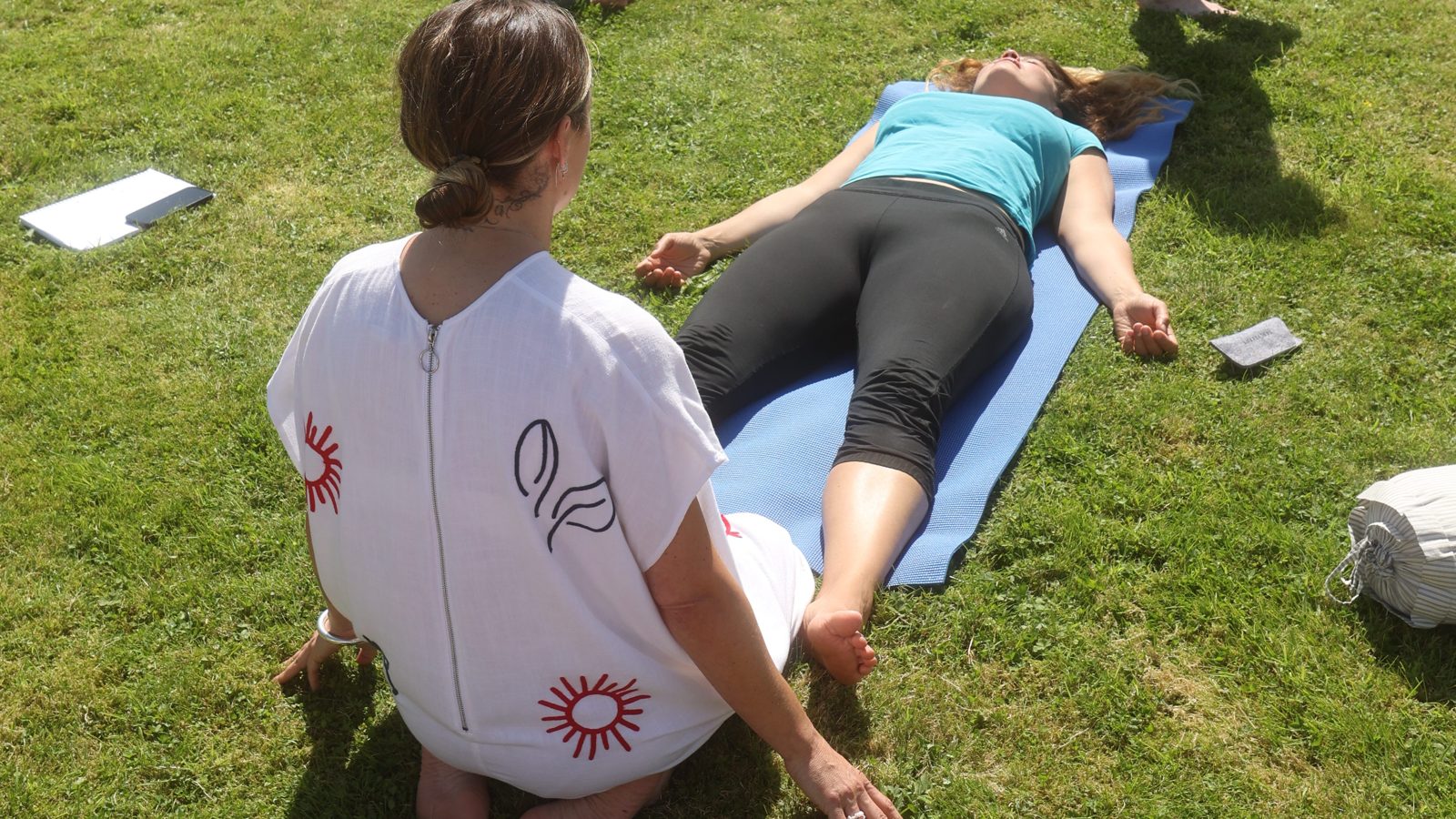
In the final phase, which I call rest and receive, you return to a natural breath. CO₂ rebuilds, tingling fades, and the calming side of the nervous system takes over. Heart rate slows and people often feel warm, soft and clear. Insights land here. Don't rush past this bit. The four phases of a session are covered in What Is Conscious Connected Breathwork?
Frequently asked questions
Does breathwork increase oxygen in the body?
Not in the way most people think. At rest your blood is already close to fully loaded with oxygen. Connected breathing mainly lowers carbon dioxide, which actually makes haemoglobin hold on to oxygen more tightly (the Bohr effect) and narrows blood vessels in the brain, causing light-headedness.
Why do my hands cramp during breathwork?
Lower CO₂ makes your blood slightly alkaline, so more calcium binds to blood proteins and less is free to steady your nerves. They fire more easily, causing tingling and then cramping called tetany. It's chemistry, not release: slow and soften the breath and it usually eases within minutes.
Why does breathwork make me light-headed?
Low carbon dioxide narrows blood vessels in the brain and makes haemoglobin release oxygen less easily, so slightly less reaches brain tissue. That causes the floaty, light-headed feeling. Always breathe lying or sitting down, and slow your breath if it becomes uncomfortable.
Why do emotions come up during breathwork?
As the breath softens the body's habitual holding, feelings that weren't safe to feel at the time can surface: tears, anger, grief, laughter. One hypothesis is that altered states quieten the brain's filtering. Our working model is that the body holds states, not just stories, and the breath gives them room to move.
Is shaking during breathwork the same as tetany?
No. Tetany is a held cramp, usually in the hands and face, caused by blood chemistry; it means slow the breath. Shaking is rhythmic trembling, often in the legs, pelvis or jaw, from the nervous system releasing activation; usually you let it run and stay present.
Is the science of breathwork proven?
Parts are. The chemistry of CO₂, pH, calcium and haemoglobin is textbook physiology. Brain changes during over-breathing have good support. Ideas about stored patterns and release are working models. Breathwork research is young, so treat confident claims with healthy scepticism.
Learn to hold this with confidence
We give clients the felt version and hold the full science ourselves. In the Journey The Breath facilitator training, Module 4 covers the science of breathwork, from CO₂ tolerance and the Bohr effect to brain states, and you learn to explain it simply to the people in front of you. The next cohort starts on 21 March 2027. See also Breathwork Contraindications and How to Become a Breathwork Facilitator.
This article is general information, not medical advice.
Sources
- Brinkman JE, Sharma S. Respiratory Alkalosis. StatPearls.
- Calcium and Sahota RJ et al., Physiology, Calcium. StatPearls.
- MedLink Neurology, Hyperventilation syndrome.
- Merck Manual Professional Edition, Hyperventilation Syndrome.
- Havenith MN et al. (2025). Decreased CO₂ saturation during circular breathwork supports emergence of altered states of consciousness. Communications Psychology.
- ANS/BSCN, Guidelines for Hyperventilation During EEG Recordings (PDF).
- Dietrich A (2003). Functional neuroanatomy of altered states of consciousness: the transient hypofrontality hypothesis. Consciousness and Cognition 12:231–256.
- Goodwin DW et al. (1969). Alcohol and recall: state-dependent effects in man. Science 163:1358–1360.
- Murre JMJ (2021). The Godden and Baddeley (1975) experiment on context-dependent memory on land and underwater: a replication. Royal Society Open Science.
Related reading: trauma-informed somatic breathwork training.
