The Leaving Pattern (Schizoid Character Structure): Coming Home to the Body
Feel called to share this work? Explore our 200-hour conscious connected breathwork facilitator training →
New to breathwork? Join Pat's free weekly online Community Breathe
Quick answer: The Leaving pattern, called the schizoid character structure by Reich and Lowen, is the earliest of the five character structures. It forms between conception and about six months, when the world feels unsafe, so the child pulls energy up and away from the body and into the mind. Adults with this pattern tend to be sensitive, creative and highly perceptive, but can feel slightly outside their own lives. Its healing is the return to the body.
You might know the feeling of being slightly outside your own life. A sharp mind, far-away eyes, more at home with ideas than with the warm mess of being close to someone. That's the felt sense of the Leaving pattern.
It's the first of the five Reichian character types, and it's where I begin when I teach this material, because it forms first, before we had words, and because everything else depends on being able to stay in your own body. You can't take a client anywhere you haven't been yourself.
A quick note on the name. "Schizoid" is the older term from Wilhelm Reich and Alexander Lowen. Here it describes a body-based holding pattern, not schizophrenia or a psychiatric diagnosis. Steven Kessler's name, Leaving, describes it better: under stress, this pattern leaves.
How does the Leaving pattern form?
The Leaving pattern forms in the earliest window of life, from the womb through to about six months old. The environment the incoming spirit arrives into feels unsafe. That can come from:
- A womb, or a first few months, that felt cold, hostile or unwelcoming.
- A mother who couldn't fully arrive, through her own depression, fear or absence, or who was present in body but disconnected from her own.
- A sensitive spirit that meets shock and pulls back rather than landing all the way in.
The baby meets energies it can't metabolise. Instead of claiming the body, it pulls away. The conclusion, taken in before there's any language for it, is: it isn't safe to be here. Stephen Johnson put the wound as "my life threatens my life." The child, in a sense, stops living in order to stay alive.
That's not a flaw. It's what a sensitive child did to stay safe.
What are the core beliefs and the wound underneath?
Decided early and carried quietly long after the words are gone, the beliefs sound like:
- "I'm not safe here."
- "I am not my body. I am my mind."
- "I don't really belong anywhere."
- "I don't have the right to exist."
The emotional weather is layered. Underneath everything there's fear, so constant you stop noticing it's there. Under the fear, a deep buried rage about not being met. Under the rage, self-hatred, turned inward where it feels safer than turning it out.
Attention naturally lives in the head. When the body isn't safe, the mind becomes home. Thinking can be fast, abstract and often all or nothing, and it scans for danger and for the way out. The intellect grows strong because it became the place to hide.
How does the Leaving pattern live in the body?
If you know where to look, the leaving is visible:
- A thin or fragile build, sometimes asymmetrical, almost like a collection of parts. There can be a split between left and right, or upper and lower.
- Cold hands and feet, and little colour in the body. Arched feet, with the weight not fully through the soles.
- Eyes that are far away, startled or scanning, and hard to meet.
- Energy pulled up and out, with very little weight in the legs. The room can feel less inhabited.
- Tension gathered at the base of the skull, the neck and the shoulders.
The breath is shallow and high in the chest, with short inhales. The diaphragm grips, and the breath stays up where the body feels safest. The breath is the first place the leaving shows, and the first place the way back opens.
How does it show up in life and relationships?
In daily life, you might notice that you watch your life more than you live it. Under pressure you go vague, scatter or disappear. You start a great deal, and a great deal stays unfinished. You forget to eat, to rest, to notice the body at all.
In relationships, you feel safest alone and need a lot of alone time. Closeness can feel like too much, so you drift. At the first sign of distress you leave, in the body if not the room. Eye contact is hard, and animals and nature feel easier than people.
What does this look like in real life?
I've worked with clients with a strong Leaving pattern who, when I first met them, seemed terrified by everything in life. So fearful. Much more comfortable with animals than with humans. Very creative, very floaty.
Over 12 to 18 months of working together, I watched them completely transform: in their energy, their posture, their presence, their resilience and their capacity. I helped them really land their gifts in the world, actually action a lot of their creativity, and make real things they'd dreamed about for years. I took them out of their heads and into life.
That transformation didn't come from pushing. It came slowly, with safety first.
What are the gifts of the Leaving pattern?
This pattern isn't something to fix. The same sensitivity that made the world feel unsafe is a real gift, and once it's grounded you can actually use it:
- You read energy and atmosphere before a word is spoken.
- You hold many things at once and see from many angles.
- You're genuinely creative, non-linear and at home in the unknown.
- You're sensitive, light, open and often quietly in service.
Under the terror and the rage sits a capacity to read energy on a level most people can't. In a facilitator, that's gold, as long as you're in your body while you use it.
The return to the body: 3 daily tools and a breath practice
Each pattern has a "return", something you already had and lost early. For the Leaving pattern, it's the return to the body: embodiment. To claim the body and learn to live as a person in the physical world. Not as an idea about yourself, but as the weight of you, here.
You don't think your way back in. You feel your way back. The story is how you leave, and the sensation is how you stay. And the first thing that meets you there is usually the fear you left to avoid, which is why warmth and safety matter so much.
Three simple daily tools:
- Feet first. Several times a day, press your feet into the floor and feel it take your weight. Notice the chair holding you. When you catch yourself up in your head, come back to one sensation.
- Hands in the earth. Pottery, wood, gardening, dance, a walk where you feel each foot meet the ground, or time with animals. Anything that brings the body into contact with the physical world.
- Touch and warmth. Massage, a weighted blanket, a hand on your own chest. And a little eye contact with someone safe, letting yourself be met.
A breath practice for the Leaving pattern: the grounding breath
The Leaving pattern breathes high and shallow. This breath does one thing: it brings you down.
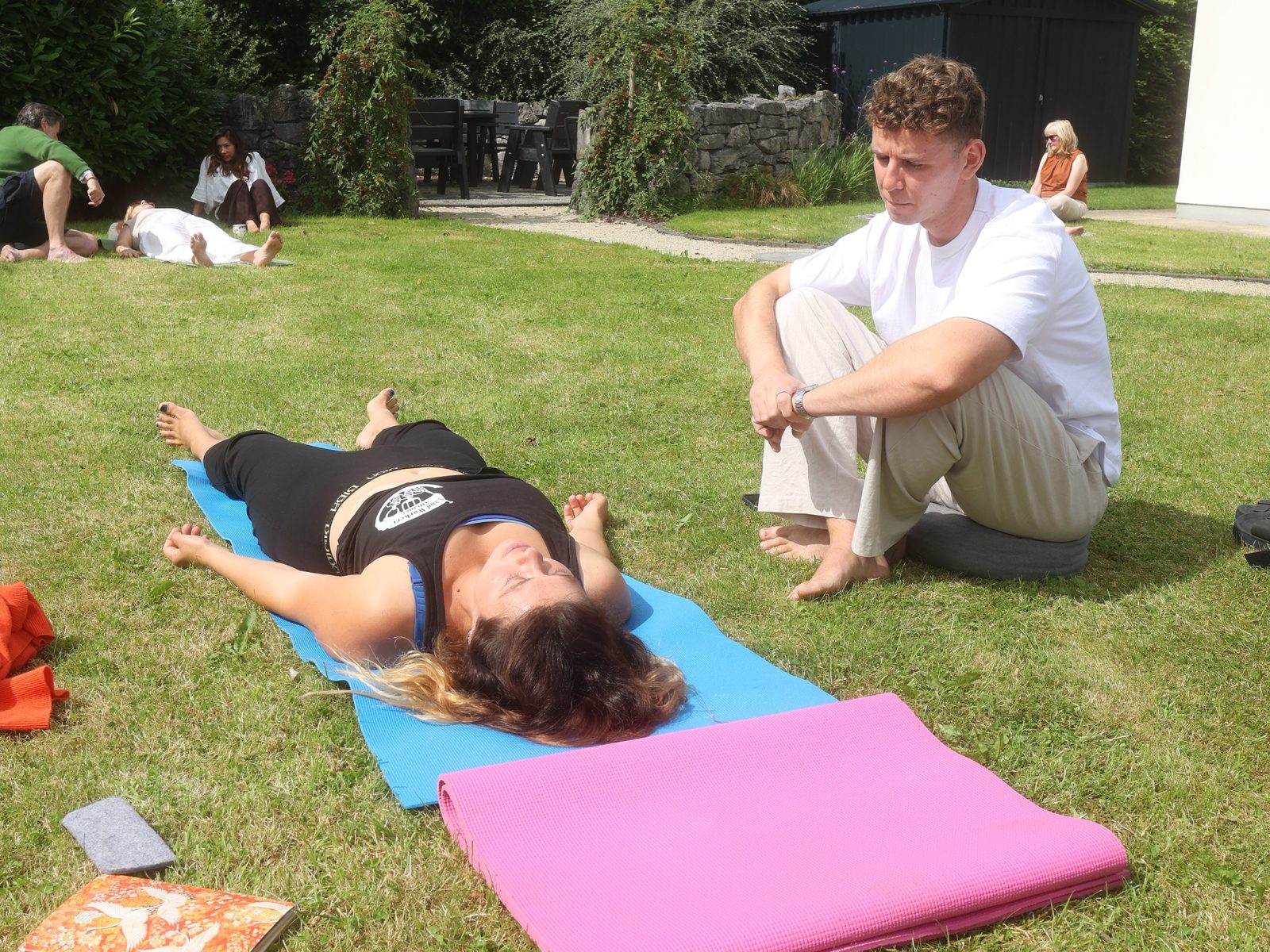
- Sit or lie down with your feet flat on the floor. Keep your eyes softly open if you tend to drift.
- Place a hand on your lower belly. Breathe in slowly through the nose, down under your hand.
- Breathe out slowly, letting your weight drop into the ground. Aim for five or six breaths a minute.
- Every so often, press your feet into the floor and feel it take your weight.
- When you float off, that's the pattern. Bring the breath back down. Each return is the rep.
Start with a few minutes. A long sigh or a hum on the exhale can help the charge drop out of the head.
How do you work with the Leaving pattern in breathwork?
Slowly. Safety first, always. The order matters more here than with any other pattern.
This is why I say breathwork is an umbrella term, like fitness. Leaving, like Merging, tends to be undercharged: there isn't a lot of energy in the body to begin with. The big, intense breath that might be just right for an overcharged Enduring or Challenger pattern can overwhelm someone with a strong Leaving pattern and send them further out of the body. I've met many people with this pattern who tried a strong breathwork session, especially in a big group, and found it overwhelming. It took them further away from themselves, and they concluded breathwork wasn't for them. Often it was simply the wrong breath for their body.
The work is to build tolerance for aliveness in the body before anything else. That means soft connected breath, bringing energy down into the belly and legs, never forced. Never high-intensity hyperventilation early on. The breath here is an invitation to arrive, not a charge to release. Avoid powerful energetic techniques too soon and avoid overwhelming intensity. Less is more.
The facilitator's own grounded presence is the medicine. Grounding, soft and slow contact, eye contact with kindness. You can't ground another person if you're not grounded yourself, which is why we meet this pattern in ourselves first. The skill I pair with it is full body listening: a body that stays in itself and stays available to another. That's exactly what the Leaving pattern needed and didn't get.
A word of caution
Please don't weaponise this material. It's not a diagnostic, and there's nothing wrong with you if you recognise yourself here. You don't have to "get past" the pattern. It's a loose map, and awareness is the first part of change, even when it's confronting at first.
Go gentle. This is slow work and, honestly, it's not sexy. It's small, consistent commitments to showing up for yourself, making new choices and slowing things down.
Further reading: for more on the Leaving pattern, I recommend Alexander Lowen's The Language of the Body and Steven Kessler's The 5 Personality Patterns.
This article is educational. It isn't therapy, a diagnosis or medical advice. If you're carrying trauma or what comes up feels like too much, please work with a therapist or speak to your GP. Before trying conscious connected breathwork, read our breathwork contraindications guide.
Frequently asked questions
What is the Leaving pattern?
The Leaving pattern is Steven Kessler's name for what Reich and Lowen called the schizoid character structure. It's the earliest of the five character structures, forming from the womb to about six months, when the world feels unsafe. Energy pulls up into the head and away from the body and from people.
Does "schizoid character" mean schizoid personality disorder?
No. In the Reichian and bioenergetic tradition, "schizoid" is an old name for a body-based holding pattern, not a psychiatric diagnosis. That's why many teachers now use the name Leaving. If you're concerned about your mental health, please speak to your GP or a mental health professional.
What are the signs of the Leaving pattern?
Common signs include living mostly in your head, cold hands and feet, far-away or scanning eyes, little weight in the legs and a high, shallow breath. Under stress you may go vague or disappear, and you may feel safest alone or with animals and nature.
What breathwork helps the Leaving pattern?
Gentle, grounded breath. Soft connected breathing, a slow breath low into the belly and a longer exhale help bring energy down into the body. High-intensity breathwork early on can overwhelm this pattern, so a good facilitator builds safety first and goes slowly.
What are the gifts of the schizoid or Leaving type?
Once grounded, this pattern brings real sensitivity: reading energy and atmosphere before a word is spoken, seeing from many angles, deep creativity and comfort with the unknown. Many people with this pattern are quietly in service, and their perceptiveness is a genuine strength.
Two ways to go deeper
- Train as a facilitator. Journey The Breath is our 200-hour conscious connected breathwork facilitator training: six months online, three days together in Galway, then six months of support. We've trained 160+ facilitators in more than 20 countries. The next cohort starts on 21 March 2027, and the following intake on 15 August 2027.
- Breathe with us. Community Breathe is our online breathwork community, with the next sessions starting on 9 January 2027. A gentle way to practise coming home to the body with others.
Keep reading: Reichian Character Types: An Introduction · Next: The Merging Pattern (Oral Character Structure) · What Is Conscious Connected Breathwork?
